Showing posts with label Articles. Show all posts

Thursday, October 18, 2012

Advice For Canadian Home Buyers

The Canadian premiere of Mike's new show a couple of days ago has fatigued me to the max, and I haven't even seen it. Since The Holmes Spot has been thanklessly covering all the buzz, from Facebook and Twitter, to HGTV and ET Canada, I figured it's time for a break. Shortly before the new show aired, an article was posted to the Ottawa Citizen in regards to the cooling Canadian housing market. Mike advises people to consider all the variables when buying a home and make a wise decision. Buying a home is a huge investment, and it's not something that should be done without a great deal of thought. He also talks about the new show as well. It's a great little read...


Mike Holmes, host of new HGTV series, has advice for Canadian home buyers

 
Mike Holmes, host of new HGTV series, has advice for Canadian home buyers

Mike Holmes is shown in a recent handout photo. With Canada's housing market showing signs of cooling, prospective buyers need to stop looking for their "dream home" and be practical, says celebrity contractor Holmes.THE CANADIAN PRESS/ho-Susan Snee

TORONTO - With Canada's housing market showing signs of cooling, prospective buyers need to stop looking for their "dream home" and be practical, says celebrity contractor Mike Holmes.
"We need to buy with a solid mind, meaning, is the area smart to buy in?" the construction and renovation expert said in a recent phone interview to promote his new series, "Holmes Makes It Right," debuting Tuesday (at 9pm ET/PT) on HGTV Canada.
"What is the area? Does it contain asbestos, does it have termites in the area? We can find all this out before we look but we're not doing that little bit of homework that is so necessary, even trying to find the right home inspector before we buy," he added.
"When it comes to your home, one thing that's really clear: this is about the most money you're ever going to spend in your life — don't you want to spend your money right? Buy with a proper conscience of what you need to buy and not of what you think you want."
In "Holmes Makes It Right," the beloved, brawny Toronto native does what he did in his previous series, "Holmes on Homes" and "Holmes Inspection": he comes to the rescue of distraught homeowners suffering from contracting work gone wrong.
Only this time, he's also taking on larger projects, including the redesign and build of an arson-destroyed High Park playground in Toronto, and the construction of an accessible outdoor deck and dining area for a paralyzed teacher.
"The storyline in 'Holmes Makes It Right' is so much bigger and I'm the type of guy, I can't turn a blind eye to something," said Holmes, who is still in touch with many of his clients from past episodes and often gets thank-you presents and cards from them.
"So if I actually walk in the house and I see a lot more wrong with it, I'm my own worst enemy because then I'll say, 'We need to look into this, we need to look into this,' and before we know it, from what is scheduled to be a three-week job turns into six months of construction and a half a million dollars later."
Holmes said when he first agreed to be on television over 10 years ago, he vowed it would just be for two years because he's too busy.
"And 'Hotel California' stepped in where you won't let me go," he said with a laugh, noting that out of the 100,000 emails he gets from viewers a year, "probably 60,000 of them are begging for help and are in real turmoil."
"That I can't help everyone is the hardest thing that I face. I wish I could. A lot of these people may go bankrupt, lose their home ... (go through) divorce — I call it divorce dust. But I'm doing what I can and I'm trying to teach so they don't fall in this trap."
While Holmes may hear from viewers often, that's not the case when it comes to the contractors whose shoddy work led to the disasters he sees in homes.
"Out of almost 200 shows that I've finished by this date, there's only two contractors that I've heard from," he said. "They put the tail between their legs and sort of run. It's a shame but it's expected.
"They realize they were wrong and I can only hope that the majority learn from what they saw on television."
Holmes figures his services are so in demand because of "an epidemic" of poor construction.
"We're building wrong in the first place," he said. "We're building with minimum code and not even trying to push above that or at least educate as so why you should."
Holmes often hears about minimum-code problems from condo dwellers who tell him they can hear — and smell — their neighbours.
"STC means Sound Transmission Class and that's around 50 when it comes to a condo," he said.
"The truth is, we knew the sound transmission class of 50, you can hear your neighbour and more than likely you'll smell them too. Don't you think you'd want them to up it a bit, shouldn't the condo guys be upping it? I would, and brag about it."
One of the biggest pieces of advice Holmes has for prospective buyers is to look for the year in which the home was built.
"Anything before 1980 has a possible 50/50 chance of containing asbestos in the plaster, tile and attic insulation. And if you just knew that, that's education."
They should also insist on getting a home inspection, even if the real estate agent discourages it in order to secure a strong bid.
"Don't buy the house without it," said Holmes.
"How many times do I see a real estate clipping that says, 'All new electrical, totally renovated, just gorgeous, move-in ready.' Meanwhile, did (the real estate agent) even check to see if there were permits pulled or did they even care?"
When it comes to hiring a contractor, homeowners should look for a passion in the person they're hiring.
"It's about caring and I always do it in a simple equation — we've got two cooks, one loves to cook, one hates to cook. What burger do you want to eat? Really simple, right?" said Holmes.
And with the cooler temperatures setting in, Holmes advises homeowners not to wait until the last minute to do seasonal maintenance: make sure the furnace is working properly, the ducts and fireplace flue/chimney are clean, and the roof is in good condition.
"When it comes to your home, learn what you need to do. Start from the outside, work your way in. Do not start from the inside and work your way out. I can't say that enough."

Friday, August 24, 2012

That "New Car Smell" May Kill You!

Everybody loves the smell of a new car. Mmmmm... or a brand new iPod, all shiny and clean. You unwrap the cellophane and carefully take it out of its box. Suddenly, that unmistakable "new gadget" aroma fills the room. Ever wonder what it was that makes new things smell so...smelly? Unfortunately, some of the odors given off by building materials, such as plastics, woods, carpets, and paints are actually chemical fumes evaporating into the air. These chemical fumes are better known as VOCs, or volatile organic compounds, and in some cases they can be toxic. New homes or newly renovated homes often contain many materials that will off-gas VOCs for days, weeks, or even months. Certain kinds of caulkings and pressed wood cabinets are often the biggest culprits for VOCs. So, what's the solution? There really is no grand solution that totally eliminates the emission of VOCs in the case of a new or newly renovated home. Your best bet is to mitigate the problem by choosing better, higher quality products that contain little or no VOCs in them. Choosing natural products such as glass or stone over synthetic products such as vinyl is preferable. The trade off? Natural products are usually much more expensive than synthetics, but they're safer in your home, and they're usually a higher quality product that you'll probably be happier with in the long run.

In this article, reposted from Canada.com, Mike explains why that "new car smell" may be hazardous to your health! (Don't shoot the messenger! Just read the article.)


The ABCs of VOCs

Undated handout photo of painting crew. Homeowners should choose low-VOC options during new home construction and renovation projects, such as Green Seal paints and hardwood floors.

Photograph by: Alex Schuldt, The Holmes Group

VOCs, or volatile organic compounds, are chemical byproducts found in many building supplies and products. Treated wood, insulation, carpeting, paints and cabinets all contain VOCs that will evaporate or off-gas into your indoor air.
You can usually smell VOCs the strongest in varnishes and some paints.
They're also in cigarette smoke, exhaust fumes, air fresheners, furnishings and
plastics.
It's almost like we've been programmed to like the smell of VOCs because we normally smell them when we get something new, like a gadget or even a new home or reno. But VOCs have been known to cause headaches, dizziness, and can be toxic in some cases.
New homes have higher levels of VOCs. The same goes for renovations. VOC levels will decrease over time due to off-gassing. But how long they off-gas depends on the material.
For example, adhesives and caulking are among the worst for off-gassing and VOCs. That's why you're supposed to stay out of bathrooms for at least a couple of days after caulking. Whereas VOCs in spray foam will be gone or non-detectable within a few days. But pressed wood cabinets will off-gas for weeks - sometimes even months. In fact, cabinets are huge VOC contributors.
Part of the reason is because of the adhesives and varnishes some cabinets contain. These are cabinets usually made from pressed wood, particleboard or MDF (medium-density fibreboard). But a lot of it has to do with just the number of cabinets in a house.
Think about it: Most homes have cabinets in the kitchen, dining room, living room, bedrooms and bathrooms. This will all add up and increase the amount of VOCs in the air inside your home.
Spray foam
I get a lot of questions from homeowners asking me about the off-gassing from spray foam. Spray foam is a safe product as long as it's installed properly. The standard curing time is 24 hours. The problem is when you get inexperienced contractors installing it.
For example, if a job requires more than one application you need to wait at least two hours before applying the second coat. But some installers will rush a job and not wait. When you don't let it cure the full two hours VOCs will get trapped in between the layers and then off-gas over time - usually when people are living in the home, which is bad.
Rubber Pavers
I recently got an email from a homeowner asking about rubber pavers and VOCs. He wanted to know if it was safe to install rubber pavers around his home or if it had high levels of VOCs.
Rubber pavers are a type of flooring usually made from recycled rubber, like tires. They're porous which makes them very absorbent. So be careful about potential spills. But the amount of off-gassing from rubber pavers varies between manufacturers.
Most of the VOCs in rubber pavers come from the adhesives used for installation. That's why some manufacturers are producing rubber pavers that can be installed without adhesives. The main thing to look out for is to make sure it doesn't contain formaldehyde.
Formaldehyde
This strong-smelling, colourless gas was used in a lot of building products and materials that contained adhesives, such as pressed wood. There was also a specific kind of insulation that was made from formaldehyde - Urea-Formaldehyde Foam Insulation (UFFI).
UFFI was popular in the late 70's. But then in 1980 it was banned because improper installation made it harmful for too many homeowners.
Moderate exposure to formaldehyde can cause your eyes or nose to burn temporarily and a sore throat. Higher levels of exposure can cause asthma-like symptoms, like coughing and wheezing. But very high exposures can be toxic. It's been known to even cause some cancers.
The International Agency for Research on Cancer classifies formaldehyde as a known carcinogen. Luckily, most Canadian homes don't have formaldehyde levels that can cause cancer. Its use in building materials and products has decreased over the years as well. But we should still be smart about the choices we make for our homes and indoor air quality.
Buyer Beware
Glass, ceramic tile, metal, stone and other hard and inert materials don't release any VOCs. This makes them the safer choice. Also try and stick to hardwood instead of vinyl flooring, or natural carpet instead of synthetic. If you can afford it, go for custom solid wood cabinetry with a low or zero VOC finish.
Be careful about products that claim to have low-VOCs. A company can say a product, such as paint, has low-VOCs. But it could just mean "lower than before" or "lower than another brand".
Homeowners need to look for Green Seal (GS) Standard products, including paints and rubbers. Green Seal means the product and/or material has been tested and meets environmental standards. It's a better safety indicator than just "low-VOCs".
Catch Mike Holmes in his new series, Holmes Makes It Right, premiering Tuesday, October 16th at 9 p.m. on HGTV. For more information, visit hgtv.ca. For more information on home renovations, visit makeitright.ca.

Wednesday, August 22, 2012

The Appraiser Needs Appraising

In this article, reposted from the National Post, Mike touches on what a home appraiser is, why you may need one, and how a bad one can really mess you up. "[There are] good appraisers and bad appraisers. The good ones have strong associations backing them up. And the bad ones are bad because the industry allows it — we allow it," he says. A home appraiser may look at several factors such as the area the home is built in, the value of the land, and features of the home such as energy efficient windows when assessing a home's value. Because there are no baseline qualifications for appraisers (in Canada), the level of competency can vary wildly from one appraiser to the next. It's important for homeowners to be aware of this and speak up if they feel something is wrong.


Mike Holmes: The appraiser needs appraising


Mike Holmes | Aug 20, 2012 8:00 AM ET | Last Updated: Aug 17, 2012 11:54 AM ET


Alex Schuldt/The Holmes Group Be wary of bad appraisers, Mike Holmes says.


I got an email from a homeowner who was upset — that’s nothing new. But she wasn’t upset because a contractor screwed her over, or because she got a bad home inspection. She was mad because of an appraiser.

She and her husband wanted to redo their kitchen — the previous owner of their home had done some renovations. But it was all wrong. They had bad plumbing. Bad layout. Bad tiling. Improper ventilation. And it looked ugly.

The new homeowners wanted it fixed. So they did what many homeowners do — they went to their bank for a home equity loan. But they ran into a problem.

The appraiser the bank hired decided their home’s value couldn’t support the loan. So they couldn’t refinance their mortgage, which meant they couldn’t redo their kitchen. And now they’re stuck with a bad kitchen that will probably lead to bigger problems down the road.

Was the appraiser wrong? Was their home that bad? I don’t know. I haven’t seen the house. But the homeowners didn’t think so. That’s why they emailed me. They thought the appraiser didn’t have the right skills to evaluate their home. And I’ve got to wonder.

The appraisal industry works a lot like the home inspections industry. There isn’t a single set of standards. The skills required to be an appraiser depend on the association an appraiser belongs to.

Some associations require a university degree as a first step. Others a business degree. And some don’t require a degree at all. But most appraisal associations want some kind of designation. And again, what that designation is will be different for every association.

For example, one association requires its members to have a university degree — in anything. Could be sociology or art, it doesn’t matter. Then they have to complete a university-level education program specific to appraising.

Most of the courses in the program deal with real estate and business. But what about building skills? Understanding the structure of a house? A basic understanding of construction? Knowing how one part of a home affects another? Aren’t these skills important when you’re evaluating a home? For some appraisal associations it is. But not always.

It depends on the needs of the user who hired the appraiser in the first place.

When it comes to mortgages, banks care about a home’s selling price. Why? Because if a homeowner can’t pay their mortgage the bank will have to sell their house. Banks want their money back. They want to know how much they can sell a house for. And sometimes a home’s construction has very little to do with that.

You could have a house that cost $2-million to build. But an appraiser says it’s worth $600,000. Is this fair? Where was it built? Maybe the neighbourhood’s no good, and no one wants to live there. In this case the appraiser is saying that the only way to sell the house is if it’s priced at $600,000.

Then you’ve got a market like Vancouver or Toronto. You can’t buy a house downtown for less than a million dollars. It doesn’t matter if it’s a shack. It’s all about land value.

More banks are starting to put pressure on appraisers. They’re looking to the U.S. and trying to avoid their mistakes. Inflated house prices plus record debt levels are a bad mix. They want to make sure that if an appraiser says a property is worth $500,000, they can sell it for $500,000.

But if an appraiser’s job is to know how much a house is worth, they should know about construction. That’s basic. You should know how a home works, signs that tell you if there are any huge costs, the difference in finishes, how different improvements affect the value of a home and how different climates affect materials.
I’ve heard of homeowners having to point things out to an appraiser; things like radiant in-floor heating, Low-E windows, a metal roof — even a finished basement. Or some appraisers will ignore mould, faulty electrical and HVAC. These have a huge impact on the value of a home.

Having a basic understanding of a home’s structure, materials and mechanics — and knowing how each affects value — is logical. It’s essential. How do you value something you don’t understand? It’s like being a jewellery appraiser and not knowing about different stones, cuts, metals or colours.

Are business skills important for appraisals? Absolutely. But so are building skills. You need to know the signs that tell you what a house is worth. Believe me — a fresh coat of paint can hide a world of trouble. And it can be really deceiving for someone who isn’t trained to look for the signs.

We have good contractors and bad contractors. Good home inspectors and bad home inspectors. And good appraisers and bad appraisers. The good ones have strong associations backing them up. And the bad ones are bad because the industry allows it — we allow it.

If we want to change the industry we all have to be watchdogs. If you think an appraiser is wrong, tell them. Speak to their association. You might need to point things out. They might listen. And you might help make it right.

Monday, August 6, 2012

Mask Your Identity

I think it goes without saying that breathing is a vital part of life, and maintaining a healthy set of lungs is key to longevity. In this article, reposted from the National Post, Mike talks masks, or respirators, and their importance on the job site. Masks should be worn any time there's the potential for exposure to hazardous airborne contaminates, such as gases or fumes, or even airborne particles such as sawdust. It's important to choose the right respirator for the job you are doing, and to always check the seal, because a mask is useless if it's not properly sealed. Facial hair, even stubble, can break that seal, so it's important to think and plan ahead if you know you're going to be exposing yourself to harmful air born contaminants.


Mike Holmes: It’s key to mask your identity


Mike Holmes | Aug 6, 2012 8:00 AM ET | Last Updated: Aug 3, 2012 1:18 PM ET
Alex Schuldt, The Holmes Group
Crew member uses half-mask respirator for protection against airborne contaminants during a home renovation job.

I remember the days when if you had work boots and a hammer you were good to work on a job site. Back then, a lot of contractors would demo a house without thinking about the potential risks, such as asbestos, mould and lead paint.

You hear the stories. Young kids, just starting to work in construction, doing demos on homes that have asbestos without any protective gear. Even some of my guys can tell you stories when they worked on other crews. They joke about it now that they know the risks: “There goes 10 years off my life.” But it’s a serious problem. Working in hazardous conditions takes a toll on your health.

This goes for homeowners and DIYers, too. You need to protect yourself when doing jobs around the house. Anyone with respiratory problems knows how important it is to protect your lungs. But even today some people are reluctant to use respirators.

Sometimes it’s a comfort issue — working with a respirator is awkward. It’s hot and it can make working more difficult. Other times it has to do with time and costs — having the right respirators and being properly trained to use them takes time and money.

If you’re in a rush to get a job done, you might not think it’s worth the extra time. But then ask yourself: How important is breathing to you?

Any time there are contaminants in the air, you need to use a respirator. Contaminants can be anything from vapours, mists, gases and fumes to actual debris such as dust, sawdust — even metal particles.

Having the right protection depends on three things: Choosing the right respirator, knowing how to use it properly and knowing how to take care of it.

However, choosing the right respirator isn’t easy. Will you be using it when there’s more than one contaminant in the air? Is the contaminant a gas, vapour, fume or debris? What conditions are you working in? What are the temperatures? Are you working in an enclosed area? How long will you be wearing the respirator for? This all matters.

There are mainly two types of respirators: Air-purifying respirators (APRs) and supplied-air respirators (SARs).

APRs are the most common. They’re used for general jobs, like sanding, spray-painting and basic demo. Some work with filters or cartridges, like half-masks and full-masks. Others don’t, such as dust masks. APRs that use a filter trap particles as you breathe in. Those that use a cartridge — such as gas masks — absorb gases and vapours.

Then there are SARs. These respirators feed clean air to the user from a compressed air tank. SARs are used for serious jobs such as remediation or installing spray foam insulation. The average homeowner shouldn’t need an SAR. If a job requires one, call a pro.

Dust masks cover your nose and mouth. They provide minimum protection. This makes them disposable. You throw them out after every use or when they’re full. How do you know they’re full? They look dirty and you’ll notice it gets harder to breathe.

Half masks require filters and cartridges you attach to the respirator. These masks are good for heavier jobs when debris or particles are in the air, such as sanding or spray-painting. Replace filters before they clog and cartridges before they’re full. A clogged filter makes it harder to breathe. A full cartridge will start to leak. In both cases, you’re breathing in contaminants. Not good.

How often you replace filters and cartridges depends on how quickly they’re getting full. If you’re a heavy breather, you’ll clog them faster.

Full-masks provide the same breathing protection as half-masks, but they also have a visor for eye protection. Whether or not a full-mask is better than a half-mask depends on the job.

Some people might think a full mask is better. But we have to remember that full-mask respirators are uncomfortable. You might want to take it off more often than a half mask, which defeats the whole purpose. If that’s the case, wearing a half mask with safety eyewear might be a better choice.

But in the end, it depends on what a safety professional recommends, what the MSDS (Material Safety Data Sheet) of the materials you use dictates and your working environment. Why is environment important? Because some contaminants, like oil, are known to break down certain filters.

No matter what respirator you have, the manufacturer’s instructions are the be all and end all for using it the right way and how to take care of it.

They tell you what filters and cartridges to use, how to put the respirator on (don) and take it off (doff) properly, and how to do a seal check; it’s different for every respirator.

Every time you use a respirator, you need to do a seal check. If the mask isn’t sealed it’s useless.

A beard, long sideburns and even stubble breaks the seal. My guys shave if we’re using respirators on a job. Luckily, I don’t have to worry about the girls on the crew.

If you don’t wear a respirator when you should, you’ll be seeing interesting stuff for a week every time you blow your nose. But more importantly, you’re risking your lungs. No job is worth that.

For more information on how to choose, use and care for respirators contact the Canadian Standards Association. You can also contact governmental occupational health and safety officials in your area.

Friday, July 27, 2012

Granite Versus Quartz — The Debate Continues

Only Mike Holmes could write an article about counter tops and make it interesting. In this article, reposted from the Ottawa Citizen, Mike discusses the differences between granite and quartz, and the pros and cons of each. Me personally? If I had to choose, I'd definitely go with quartz, because, as Mike points out, Granite is very expensive, requires maintenance (no thanks), and inconsistent due to being a natural stone. Quartz is also expensive, but at least it doesn't have to be sealed because it is non-porous. Mike does a much better job at explaining than I do. Besides, right now the only thing in my kitchen is yucky laminate. Having to choose between quartz and granite is a dream that will have to wait.


Granite versus quartz — the debate continues


Mike Holmes examines a kitchen countertop to make sure it was properly installed and level. Despite having their drawbacks, both granite and quartz are popular materials for kitchen countertops.

I’ve been doing kitchen renovations for a long time. Everything the eye sees in a kitchen renovation is the eye candy. What’s behind it all? That’s my world. But to this day, the question I get asked most about kitchen renovations is which is better? Granite or quartz?
In just about every kitchen renovation I do the homeowner wants granite. As consumers, we’ve been taught that a good kitchen will have granite countertops. Some homeowners even feel like the entire renovation is a failure if it doesn’t come with a granite countertop.
Granite and quartz are the two heavyweights in kitchen countertops. But when we talk about kitchen countertops we have to think about practicality. Should it look good? Yes. Absolutely. But my top priority is that it’s safe and does its job.
What does it mean for a kitchen countertop to be safe? That it’s non-porous and has low VOCs (volatile organic compounds).
VOCs are bad for the environment and they’re bad for anyone breathing them in. Pores are bad because they’re tiny pockets for bacteria to collect. You can contaminate any food prepared on a porous surface that hasn’t been properly cleaned.
What does it take for a kitchen countertop to do its job? It needs to be durable, stain-resistant and scratch-resistant. Most people think granite is top of the line. But it depends.
Granite is natural rock. I love natural building materials — wood, stone, straw, whatever — and I love granite. But it has its drawbacks.
For one, it’s expensive. Why? Because it’s natural. This means it comes in one big slab of stone that needs to be extracted from the earth. Extracting and shipping granite takes a lot of energy. It can be harsh on the environment.
In nature, no two stones are equal. Every stone is different. And because granite is natural, it’s not going to look the same throughout the entire slab. It might even look different from the sample you originally saw. The good news is that it’s always beautiful. It just might not be exactly what you expected.
Also, because a granite countertop is a single slab, there’s going to be a seam if your kitchen counters bend or curve. And because it’s natural rock, the seam isn’t easy to hide. It’s hard to match up the natural colours and veins in granite.
On the other hand, quartz is manufactured and coloured. What you see is what you get. Your countertop will look exactly like the sample; there are no surprises. And because it’s all one colour any seams can be hidden. This let’s us be more creative with kitchen design.
Quartz countertops are actually about 90 per cent quartz and 10 per cent acrylic or epoxy binder, like resin. The resin means quartz countertops have higher VOCs than granite. And we know this is bad for the environment and indoor air quality.
But some granite contains radon. (Remember, granite is in the ground and so is radon.) It’s usually not a huge concern. But if radon levels in your home are already an issue, granite might not be the best choice.
You’ll also need to reseal granite once a year. Granite looks solid but it’s porous. Quartz is not; its non-porous. So you’ll need to seal a granite countertop but not a quartz countertop. It’s no big deal; it takes less than an hour once a year.
Usually, a water-based penetrating (or impregnating) sealer does the trick. The silicone in the sealer works its way into the tiny pores and coats them. But it doesn’t completely seal them. That means the surface will be stain-resistant but not stain-proof. You’ll still need to quickly clean up any spills, like coffee or wine.
Quartz isn’t sealed so you don’t have to worry about sealing or stains. A rag, soap and water are all you need. And if there are tough spots, usually a vinegar-water solution is enough.
If you’re going with granite, you can’t go cheap. Why not? Because when you do, you’re usually getting a thin slab of granite. The thinner the slab the weaker it is. So what are you really buying? Know where the granite is coming from and how much of it you’re getting.
In terms of strength, quartz performs. It’s one of the hardest materials on earth, harder than glass. The way it’s manufactured mimics the way granite is made naturally — through intense pressure and heat. So they’re comparable in strength. But this process takes a lot of energy, which isn’t ideal for the environment.
Granite or quartz — they’re both good options. That’s why they’re both expensive. In some cases, quartz can be more expensive than granite. But both get a thumbs-up as long as they’re properly installed by a professional who will make sure it’s level and sealed, especially around the sinks and faucets to prevent water damage.
Bottom line: It comes down to the homeowner’s budget, the kitchen’s design, and how much upkeep the homeowner is willing to commit to.

Catch Mike in his new series Best of Holmes on Homes, Tuesdays at 9 p.m. on HGTV. For more information, visit hgtv.ca. For more information on home renovations, visit makeitright.ca.
Postmedia News

Saturday, July 14, 2012

Jamie Bell Adventure Playground in High Park Grand Re-Opening

It's been several months since Mike and his crew got involved in the rebuilding of the Jamie Bell Adventure Playground in Toronto. All of the hard work they've invested over the last couple of days and weeks paid off with plenty of "hugs and love" yesterday, July 13, 2012, as it reopened to an endless stream of grateful children, parents, and community members. This article and video from the Toronto Sun goes into details:


High Park playground replaces one destroyed by arson

visit the Toronto Sun website to view the video


By Kevin Connor, Toronto Sun

First posted: | Updated:

TORONTO - High Park’s Jamie Bell Adventure Playground reopened Friday with a brand new castle after the old one was destroyed by arson.

After the park was torched in March plans to rebuild began immediately spearheaded by HGTV celebrity Mike Holmes with the help of Toronto fire and police and members of the community.

At the opening Holmes was being repaid with hugs from the dozens of kids in attendance.

“I’m just listening to the kids scream as they come down the slide. This is all about the kids. This was a little bit of work and a lot of sweat, but it was well worth it,” Holmes said.

Michael Ogle was one of the 40 Toronto firefighters who volunteered to rebuild the park.

“Our involvement was a perfect fit for us. We responded to this fire so we wanted to be involved in rebuilding the park,” Ogle said.

The Youth Policing Students program for at risk children put some of their kids to work rebuilding the park.

“It was good. It taught me more about what work is and how hard it can be to keep going,” said 15-year-old Remington Latanville.

Kiera Walsh-Lopez, 12, has been coming to the park all her life.

“It was devastating when it burnt down. I am so glad they built it again,” Walsh-Lopez said.

The inspiration for the playground came from the community who designed and built it, said Coun. Sarah Doucette.

“This rebuild is an amazing example of how the public and private sectors can collaborate with the community to create something of value and wonder for everyone in this city,” Doucette said.

The park was able to be rebuilt after $80,000 was raised by the community and corporations.

“That this playground has been rebuilt in less than four months, entirely from the work and donations of sponsors and the community, shows how important this space is,” said Coun. Norm Kelly, chairman of the city’s Parks and Environment Committee.

“Now, due to their efforts, this playground is bigger and better than ever and will continue to inspire people in the future.”


Here's another article from InsideToronto.com:


Children run screaming with delight into new Jaime Bell playground


Children run screaming with delight into new Jaime Bell playground. The childrens Adventure Playground in High Park finally officially opened on Friday after Mike Holmes and volunteers came together to build the new castle. Children await the opening. Staff photo/IAN KELSO
LISA RAINFORD
July 13, 2012
Held back behind yellow police tape, a crowd of children waited impatiently for a chance to climb the new castle and to go down the new slides.
They watched as HGTV contractor Mike Holmes and his crew put the finishing touches on the rejuvenated Jamie Bell Adventure Playground in High Park and listened as Parkdale-High Park Councillor Sarah Doucette thanked the long list of people who made its reconstruction possible. Even though Doucette promised to keep her speech much shorter at the second grand re-opening on Friday, July 13 than that of her speech on the community build day, July 7, the children's patience waned.
"When are we allowed in?" several kids were overheard asking.
And then, for the moment they had been waiting for - for the past four months, Holmes asked, "Are you ready?"
To which the crowd cheered and applauded: "Yeah!"
"We're going to have a countdown," he told them.
From five to one they counted - followed by absolute chaos. Children ran screaming in delight as they descended upon the new structure, climbing into the castle and onto the swings and down the two slides.
"I think it's fun when the light shines on the slide making it glow red on the inside," said seven-year-old Sofia moments after she came out of the new winding slide.
Tilden, 5, called the new castle "good".
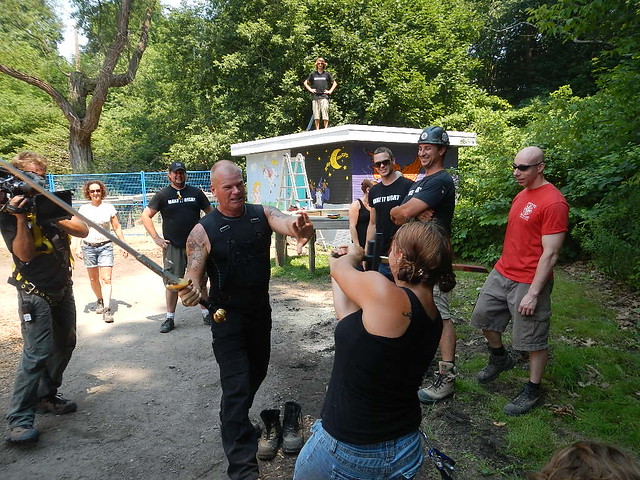
Even Holmes and his team, wearing their trademark black T-shirts, got a chance to try out the playground they had worked tirelessly on for almost two weeks. Since Tuesday, July 3, they endured sweltering temperatures and 12-hour days to get the playground rebuilt as soon as possible.
Jamie Bell's son, Adam and his niece Margot were given the honours of trying out the slides first. Landscape architect Janet Rosenberg was gifted with her own City of Toronto park plaque in appreciation for her support and talents.
In four months, the City of Toronto, financial donors and the community rallied to get the playground rebuilt.
"I think that's a record," said Doucette.
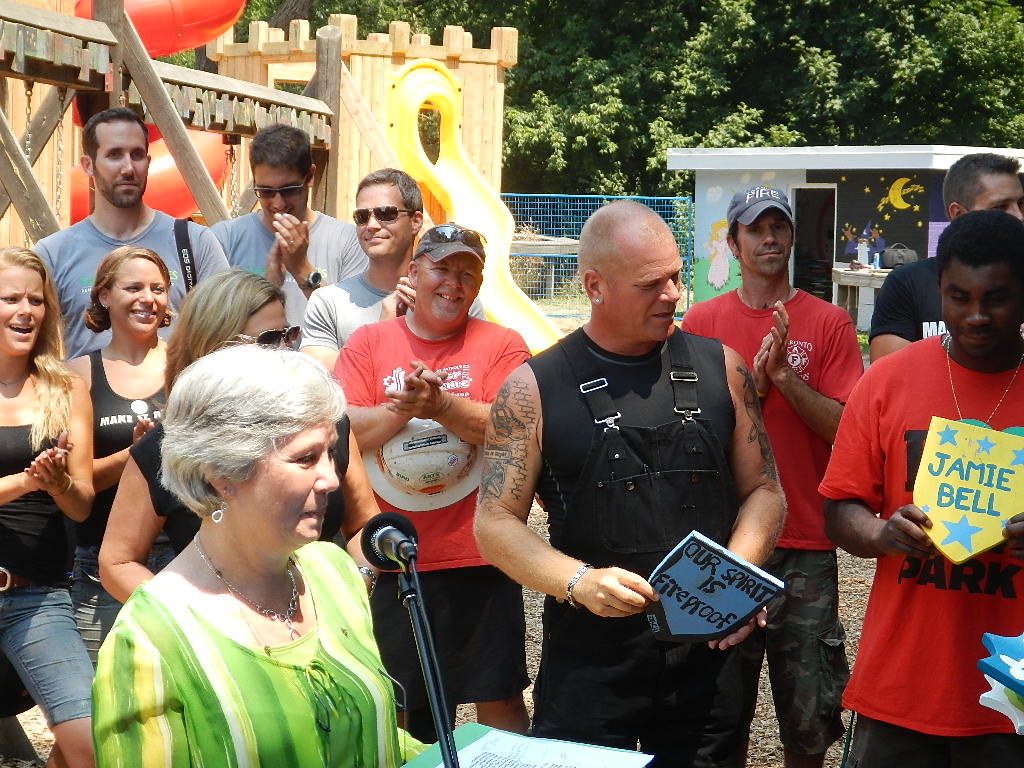
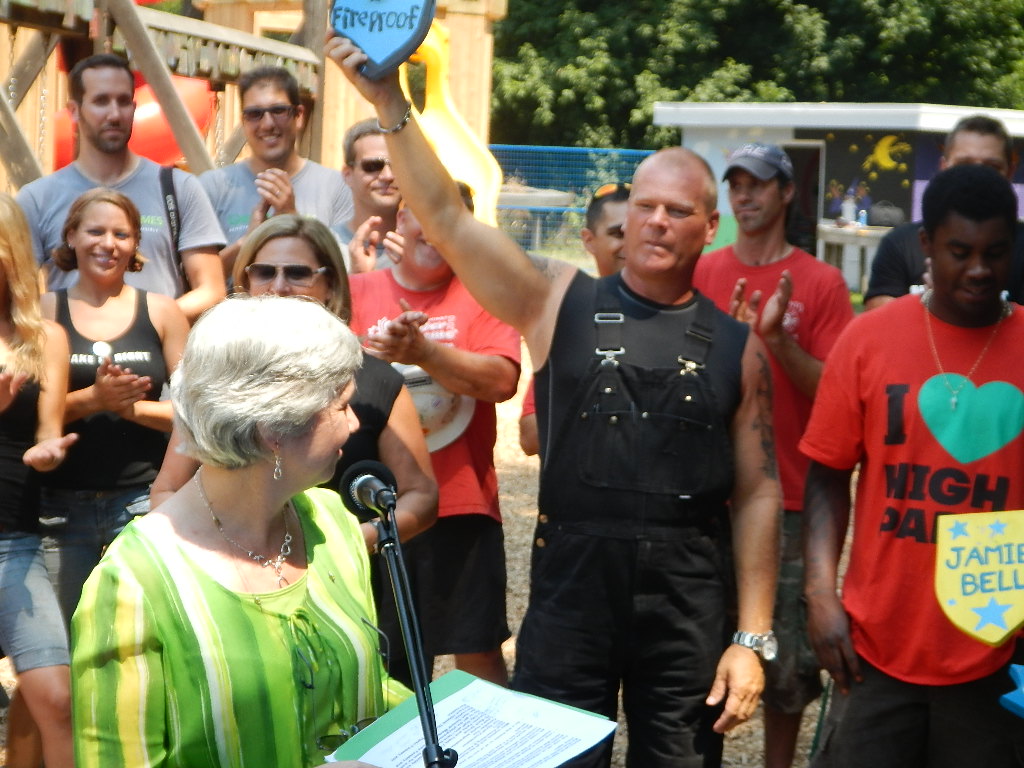
Doucette thanked Toronto Fire Services for all its support from the firefighters who came to the rescue of several members of Holmes' crew, who collapsed because of the heat a week ago to those who kept the construction site lit so they could work after dark. Firefighters were also instrumental in cutting 500 shields, which were decorated by the community - they will be installed on the playground at a later date.
'Our spirit is fire proof,' reads one of them.
On March 17, around 3 a.m. a vandal set fire to the castle turret. The community rallied, raising money and joining efforts to help rebuild within four short months.
People arrived from across the city to see the new playground.


From Mike's Facebook yesterday:

Thanks to everyone who made the Jamie Bell Playground rebuild happen. My incredible crew, all of the volunteers, Janet Rosenburg, the sponsors, the city and many many more. A special thanks goes out to the community. This was such an inspiring community project. What a great place to live. I hope everyone enjoys a new chapter in Jamie Bell's Adventure Playground.

There's a wall of kids ready to rush the castle!


It's the kids castle now! What a reveal.


The countdown is on! Just a few minutes until the kids get to play!!


And finally, here's some photos and videos from around the web about today's re-opening:


Thursday, July 12, 2012

Mike Gets Attached (And Detached)

This article, reposted from the Montreal Gazette, is one of Mike's monthly newspaper columns. In this one, Mike talks garages. Specifically, detached vs. attached garages. There are pros and cons to both. Read on...
 
__________________________________________

The rules of getting attached or detached

Mike Holmes weighs the pros and cons of attached and detached garages.

Mike Holmes weighs the pros and cons of attached and detached garages.

Photograph by: Courtesy , The Holmes Group

I love my garage. I get some of my best ideas there. It's where I go to get away from all the chaos, to unplug and decompress. Actually, it's the reason why I bought the property I live on in the first place. I'm just lucky there was a house there.
Garages are practical. Besides keeping your cars there, they're great to store tools, building materials and extra stuff like tires and bikes. You can add a small workshop in the back too, depending on how much space you have.
When we talk about garages there's attached and detached.

Attached Garages
If your garage is attached the most important thing is to make sure it's sealed. Why? To keep fumes, exhaust and carbon monoxide out of the house.
I can't tell you how many times I see in new construction where they've used a wall cavity in the garage as a return air duct to feed the furnace. You never want to use the inside of your garage as an air return.
First, you get debris being pulled inside your home. Your family breathes this in every day. Not to mention having an open cavity - which means there's no metal ducting - can draw the off-gassing from running vehicles in the garage into an open space behind the drywall.
I don't know why any builder would do this. But they do - and it's wrong. If there are vents going from your garage to the inside of your home, you need to get them redirected. You don't want to risk carbon monoxide coming inside the house. And call in a professional HVAC contractor to do the job.
You also need to make sure that a fire starting in the garage can't spread to the inside of the home. How do you do this? By having a 20-minute fire-rated door between the garage and the inside of the house. The door shouldn't open into a bedroom. And it shouldn't have a pet door either.
The door should also be about an inch thick and self-closing. All garages need a door closer on the door. Think about it: Your car's running. Fumes are going to go inside the house. Not good.
I've also seen a lot of homes with rooms on top of the garage. If there's a room above the garage it's going to be cold. Why? Because there's a lack of insulation or improper insulation. This is why we spray-foam garages. It gives us a thermal break. Not to mention closed-cell spray foam gives us a barrier between the carbon monoxide and the inside of the home.
Should all garages be insulated? It depends. What does your local building code dictate? Is there plumbing in the garage? If so, the plumbing has to be insulated. Is the garage heated? If it isn't, you don't want to insulate. Why not? Because insulating an unheated garage can cause mildew.
But if the garage is heated you should definitely insulate. Use fibreglass, cellulose, foam board or closed-cell spray foam - if it were my garage I'd go with spray foam. Then cover it with drywall for fire resistance.
Attached garages are one of the biggest sources of heat loss. Why? Because of air leakage. Garage doors are big. A lot of air can get by them. To stop this you should look into getting tube-shaped stripping for the bottom of the doors. The tube stripping forms a seal when it compresses against the floor of the garage.

Detached Garages
A detached garage eliminates the risk of dangerous fumes coming into the house. So you don't have to worry about making it super sealed. All you have to worry about is that it's the right structure and the right size.
Building a detached garage means you can make it as big as you want. Or as big as your lot allows. For me, the bigger the better. But even if you don't want a big garage, make it slightly larger than what you need - if you can.
After going through the trouble of building, make sure you've got enough space. You never know when you might need more room to store new tools, equipment, or even a new toy. Depending on the materials you use, the extra space could be worth the extra cost.
Most people don't think about their garages when it comes to renovations. But it's important. If it's attached to the house it will affect your home's safety and energy performance. It's worth bringing in a certified inspector to make sure it's properly sealed and to code.
And if you're going to build a detached garage make sure you hire pro. Check references and take a look at other garages they've built. See how they've held up through the seasons. Speak to past clients. Are they happy with the contractor's work? Doing your homework can save you money and a world of grief.

Wednesday, July 11, 2012

Don't Call Mike Holmes...

This little article, published by the Chronicle Journal, talks about some of the ways to avoid having to call Mike Holmes with your own sad reno-nightmare. It's true, Mike gets many desperate pleas for help, but he's only able to reach a small portion of those who need him. As the article points out, a little bit of prevention is worth all the cure in the world. Research and education are the keys to a successful renovation, and rushing can only lead to disaster. When it comes to your home, take your time and do it right so that Mike doesn't have to come bail you out.

Long story short, the only time you want to call Mike Holmes is to invite him over for a beer, not to beg him for help.


Don’t call Mike Holmes


Tuesday, July 10, 2012
MIKE Holmes is a popular fellow. And why shouldn’t he be? It seems he’s the only person standing between hapless homeowners and the seeming army of crooked contractors and renovation types who promise good work at fair prices, only to create havoc and leave behind a mess to fix.
Holmes, the popular host of HGTV’s Holmes Makes It Right, makes a very good living fixing those messes. And he has no trouble finding people who have had horrible experiences in the wild west home renovation market. One episode features the show’s producer and director who say they have trouble choosing among so many sad stories. Many homeowners don’t know how badly they’ve been taken until Holmes and his crew pry apart houses to find shoddy workmanship done on the cheap.
What does it say about the renovation industry when a handyman can make a career out of undoing what others in his business have done so badly? It says that you cannot trust anyone who you ask for a price on repairing, renovating or improving your home without doing some serious research.
Do that and you will find the good people. Don’t and you will end up among scores, hundreds, thousands of Canadians left with cheap work intentionally done badly. Often, it’s because the person or business hired has taken on too many jobs at once. Juggling them all in a short Canadian building season means the date you were promised the job would be completed can come and go with much more left to do, at times meaning you cannot live in your own home yet. In order to finish your job and move on, corners are cut, then covered with drywall and plywood.
This newspaper annually directs angry, frustrated readers with renovation woes to the chamber of commerce (most small, private handymen aren’t members), the Better Business Bureau or their MPPs for possible help through consumer legislation. But, as Holmes often finds, these roads can lead nowhere and homeowners are left to take the matter to small claims court. Incredibly, these courts often find in favour of fly-by-night renovators who successfully argue that work was done. It’s a matter of opinion whether it’s quality work, and officers of the court do not come by to see how bad it can be.
That’s where Holmes comes in. Homeowners lucky enough to be selected for his expertise get huge reductions in the cost of the work left to do because those who end up doing it right get exposure on Holmes’ popular show. But in order to get there, one usually has to have spent their life savings and more with no end in sight to the job they thought they’d agreed to.
Holmes invariably finds work done badly, or dangerously, and his anger at those who soak homeowners and give his industry a bad name is palpable.
It can be exciting to plan and prepare for home improvements. But don’t rush into anything. Once you’ve talked to someone in this business, take a few days to think about it. Don’t sign anything on the spot. When you do, make sure it says what you want it to say.
Ask for and check references. The company can also be checked out with the chamber of commerce and Ontario’s Ministry of Consumer and Business Services.
Ask for a written estimate. Then get at least two more estimates from reputable businesses in your area. That big saving may be a sign of a deal too good to be true.
Have any proposed contract checked over by someone trustworthy — ideally, a lawyer — before signing it.
There are three columns of Renovations and Home Improvements listings in the Yellow Pages of the Thunder Bay phone book and more advertising in newspapers. Some have been around for years, which usually means they are trustworthy. Some are smaller, independent contractors anxious to do good work to make a name for themselves. Some may be crooks looking to take your money in return for the assurance of quality workmanship that is anything but.
Mike Holmes is a nice guy, but you don’t want to call him.

Friday, July 6, 2012

Mike and Crew Down To The Wire On Jamie Bell Playground Rebuild

Mike and crew are working like busy little bees trying to get the Jamie Bell Adventure Playground, which burnt down in March of this year, rebuilt and ready for reopening this Saturday, July 7, 2012. Fighting record summer heat and tough time constraints, they're racing towards the finish line, full speed ahead. The question stands, will they meet their deadline? I guess we'll all find out for sure on Saturday! But experience tells me that even if it comes down to the wire, Mike and crew will pull through. They always do, and with the support of the community behind them, there's no way they can fail. The build is being filmed for Mike's new show, HGTV's Holmes Makes it Right, set to air this fall.

From Mike's Facebook page yesterday (he seems quite optimistic):
On site rebuilding the Jamie Bell Playground in High Park. The structure is up - but we have lots to do. Its huge! The kids are going to love it. The clock is ticking...

Photo: On site rebuilding the Jamie Bell Playground in High Park. The structure is up - but we have lots to do. Its huge! The kids are going to love it. The clock is ticking...


You can read more about Mike's latest work on the Jamie Bell Adventure playground in this article from thestar.com.

High Park’s Jamie Bell Playground rebuild goes down to the wire

Published on Thursday July 05, 2012
                              
Stephanie Law/Toronto Star                   
The Jamie Bell Playground in High Park is being rebuilt for a scheduled reopening on Saturday. Mike Holmes from HGTV is orchestrating the reconstruction while his film crew shoots the process.
Stephanie Law
Staff Reporter
Celebrity home renovator Mike Holmes is used to working under extreme pressure and time crunches. But reconstruction of the burnt-down playground in High Park is proving to be a challenge, even for this maestro of construction.
“I’m trying to do it by Saturday, even though tomorrow’s supposed to hit a record-breaking degree,” the host of HGTV’s Holmes Makes it Right said Thursday.
“Will we make it work? Well, it won’t have anything to do with not trying.”
The reopening of the Jamie Bell Playground is scheduled for Saturday, when hundreds of children and their parents will help with the finishing touches. The community rebuild will see dragons and fairies painted all over the playground’s castles, among other activities.
The popular playground, built in 1999, was torched by vandals in March. The community wanted it back for the summer.
Holmes and his crew — which includes people filming the rebuild — started work last week, beginning at 6:30 a.m. daily. Very late nights are expected to meet the deadline.
On Thursday, the “supercastle” was starting to come together. It was still hard to tell what to expect, but at least two of the towers were already complete. The design includes a drawbridge and climbing wall, features that children told Holmes and landscape architect Janet Rosenberg they wanted.
“You climb to a certain height, and you can crawl through a window and then you’re into another castle, and then you can walk across the planks to another place,” said Rosenberg, referring to the climbing wall.
Throughout the design process, the team has heard from parents, kids and the community — sometimes, parents and kids had different ideas. In the end, Rosenberg said, “that the sense of adventure was very much informed by the kids.”
So far, those involved in the project have kept mum about what the supercastle will look like.
“Wait till you see it,” said Holmes. “You won’t believe it.”


_____________________________________________

The Ward 13 official website also contains a message from City Councillor Sarah Doucette and some information about the build, geared for volunteers wanting to help:


Friends and Constituents,
I would like to thank you for visiting my website. On December 1, I celebrated the one year mark as your City Councillor for Ward 13. Please share your thoughts with me through my Contact Page so I can hear your ideas on how we can work together to continue to improve our ward and our city.
Best regards,


THE JAMIE BELL PLAYGROUND

Rebuild this Saturday, July 7!

Update: My office has recived hundreds of phone calls and emails with offers to volunteer at the Jamie Bell Playground Community Build Day. As you know, a fire at the playground on March 17 destroyed a large portion of the structure. Since then, Parks, Forestry and Recreation staff have worked with the community, my office, and donors such as Canadian Tire, Lowe's, TD Canada Trust, Mike Holmes' Make it Right and Janet Rosenberg Landscape Architects to develop and design a new castle playground structure to replace the portion that was destroyed. I am also very pleased to be working with our Community Volunteer Co-ordinator, Robin Sorys, in organizing your participation at the event.

The Community Build Day is Saturday, July 7 between 9 a.m. and 5 p.m. (registration begins at 8:30 a.m.). We have divided the day into shifts:


Shift A 9 am - 11 am

Shift B 11 am - 1 pm - at 12:00 we will be unveiling the castle

Shift C 1 pm - 3 pm

Shift D 3 pm to 5 pm or when finished - the ribbon cutting ceremony and speeches will take place at 5 pm (Then back to work if construction is not finished!)

If you are able to join us at any of these times:
· Please RSVP by Wednesday, June 27 to jamie.bell@highpark.org by cutting and pasting this section into your email with your answers beside each question.
· Please tell us how many will be coming to volunteer: how many children (under 16) and how many adults
· Tell us which shift you would like to volunteer for A, B, C or D.
· Please also indicate if you have any skills that may help us place you at work areas.
Here are some tips to help you enjoy the day:
· If you wish to volunteer on the playground site you must wear closed toed shoes as no open-toed shoes will be allowed.
· There will be limited parking so we encourage everyone to walk, bike or take TTC. If you do drive please enter off Parkside Drive. Volunteers who have registered will be given priority for parking near the site. Other parking can be found throughout the park and along Lake Shore Blvd W.
· The City's H2O TO GO will be on site so bring your reusable water bottles, they'll be easy to refill.
· There will also be children's activities and a barbecue throughout the day.
· The City as well as the producers of Mike Holmes' Make it Right have requested that clothing with logos not be worn that day. We will be providing t-shirts – hopefully for everyone and that's why we need to know who is attending. They also suggest not wearing white that day.
Finally, please carefully review the attached documents which are the Personal Release for the TV production and the Volunteer Placement Agreement Release and Waiver. Print off and sign both for each person volunteering and bring the forms with you to be handed in at the registration table when you arrive. Please remember that registration begins at 8:30 a.m.
For the volunteer agreement, please click here.
For the Make It Right release form, please click here.

Monday, July 2, 2012

Watchdog Nation Partners With Mike Holmes

So here's the scenario. An elderly man hires a couple of brothers to trim some trees on his property. While they are there, they point out to the man that his foundation is cracked, and offer to fix the problem. The elderly man shells out an exorbitant amount of money and the two guys patch a few cracks with cement and caulk around some windows, then take off with the money. This is pretty much what happened to 79 year old Royce Benson, who gave two ex-convict brothers $19,000 for foundation repairs that were never done. Luckily for Royce, his story caught the eye of Dave Lieber, a columnist for the Fort Worth Star Telegram. His coverage of Royce's story not only led to the arrest and sentencing of the brothers to four years in prison, but also caught the eye of Mike Holmes, who offered to help make it right for the elderly man. Check out the video and story below from Watchdog Nation:


Watchdog Nation partners with Mike Holmes

We work with the HGTV Star to “Make it Right!”
Watchdog Nation, the Fort Worth Star-Telegram and HGTV star Mike Holmes joined with some caring businesses to fix a heartbreaking problem involving an elderly man who lost $19,000.
Royce Benson gave two ex-convict brothers money for foundation repairs that were never done.
The story, which first appeared in a Dave Lieber column in the Fort Worth Star-Telegram, led to a series of events that resulted in one the culprits getting sentenced to four years in prison.
After the original story appeared, staff members for Mike Holmes contacted Watchdog Nation and asked if they could help fix the house of 80-year-old Royce Benson for free.
Watchdog Nation Dave Lieber partners with Mike Holmes
Mike Holmes

The Fort Worth Star-Telegram and Watchdog Nation worked with Holmes to get area companies and suppliers to donate their time and materials. Thanks to Perma-Pier Foundation Repair of Dallas, Roto-Rooter of Fort Worth and Lowe’s for banding together and, in the motto of Mike Holmes, working to “make it right.”

Watchdog Nation founder Dave Lieber partners with Mike Holmes
Royce Benson points to a sample of the awful foundation repair job. He paid $19,000 for nothing.
Watchdog Nation founder Dave Lieber partners with Mike Holmes

Hubert Burdick runs a small remodeling business. He promised to do foundation work but never did. Photo: Texas Prison System

Billey Ray Burdick runs a tree-trimming service. He accepted two of Royce Benson's checks that were made out to him. Photo: Texas Prison System


 Read about this story from the January 2011 edition of Holmes Magazine.


Sunday, July 1, 2012

Catching Up With Mike Holmes

First of all, a very happy Canada Day to Mike Holmes and all of my Canadian friends!

I found this short interview/article on the New York Times website. I really enjoyed it! Most interviews with Mike are pretty standard, and they all kind of revolve around the same information, but this one had a slightly personal slant, with lots of little useless factoids for fans to gobble up. Being the self-proclaimed Holmes queen that I am, most of this stuff is old news to me, but some of it I'd never heard before. Like, 'ello, 'ello... Mike Holmes was a D.J.??? Ex-queeze me, when was this? My curiosity is killing me! As far as Mike being a great dancer, that is something I'm dying to see. I've heard him talk about "shaking his pants" before, but I'm a wee bit suspicious. Perhaps some proof, Mike? An online video of you doing the Macarena or shaking your groove thing? We're waiting with anticipation... :) Now, I'm going to go enjoy some fireworks and make myself a Holmes-tini in honor of Canada Day and The Fourth of July. Cheers!


Catching Up With Mike Holmes


Mike Holmes is a Canadian building contractor and host of the television show Holmes on Homes, which airs on HGTV.
The Holmes Group
READING I love to read but don’t have much time to read books — some of my favorite books are by Dean Koontz — but what I am reading right now are architectural drawings for projects we’re doing, like the castle to replace the one that burned down in the playground at Toronto’s High Park a few months ago. We went to the community and had meetings and talked to the kids. We offered to make it bigger, and there’s going to be a drawbridge. The kids said they wanted more slides, so there will be more slides. The fun part was working with the kids.
LISTENING I probably listen to more reggae music than the average person — Beres Hammond and Freddie McGregor, artists like that. I love to dance so I like dance music — not the Bee Gees, but really good dance music like Next’s “Too Close” — music that makes you want to get up and move. I used to be a D.J. so I’m into stereos and dancing. It stems from my mom’s family — they’re all really good dancers. Um, yeah, people would say I know how to move.
WATCHING The television show “Touch” with Kiefer Sutherland. It’s in the realm of real, and very well-produced. It makes you pay attention and stay interested because you really want to find out who the kid is saving through his father.
FOLLOWING WorldSkills is like the Olympics except for skilled trades. Every two years, electricians, plumbers, carpenters, gas fitters, hairdressers and food servers from around the world compete for the gold medal in their category. For carpenters, they may have to build and do all the calculations for a great outdoor shed. A gas fitter may have to do a labyrinth piping system. An electrician may have to put together an alarm system. And they have a time limit to do it to perfection. It is so inspiring. It should be televised, but you can watch past competitions on the Web site.
WEARING I love watches and I have a lot of them, especially the big ones like my U-Boat and Nixon. It’s a bit of a passion of mine. Like women and shoes, I’m the watch guy.
DRINKING I’ve never really liked martinis so it became a personal challenge to come up with a mix that I would like. I came up with the Holmes-tini: 1 ounce vodka, 1 ounce coconut rum, 1 ounce peach schnapps, 1 ounce pineapple juice. I’ve ordered it at bars right across Canada, never mind the United States, and I’ve had so many restaurants ask me if they can put it on the menu. I said go ahead. You’ve got to try it, you’ll like it.

Kate Murphy is a journalist in Houston who writes frequently for The New York Times.